Keeping this in consideration, what is the process of Serpentinization?
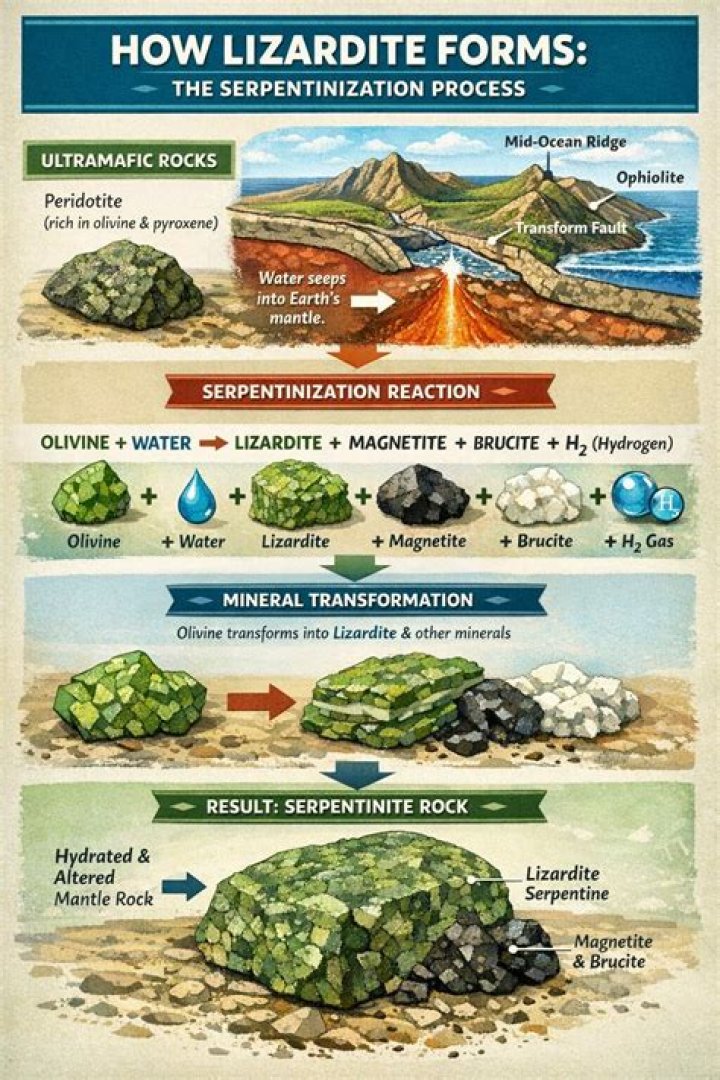
Serpentinization is a processes whereby rock (usually ultramafic) is changed, with the addition of water into the crystal structure of the minerals found within the rock. A common example is the serpentinization of peridotite (or dunite) into serpentinite (the metamorphic equivalent).
Furthermore, where is serpentinite found? Serpentinites and Serpentine Formation Ultramafic rocks are rare at Earth's surface but are abundant at the oceanic moho, the boundary between the base of the oceanic crust and the upper mantle.
Additionally, what is serpentinite made of?
Serpentinite. Serpentinite is a metamorphic rock that is mostly composed of serpentine group minerals. Serpentine group minerals antigorite, lizardite, and chrysotile are produced by the hydrous alteration of ultramafic rocks. These are igneous rocks that are composed of olivine and pyroxene (peridotite, pyroxenite).
What are ultramafic rocks made of?
Ultramafic rocks (also referred to as ultrabasic rocks, although the terms are not wholly equivalent) are igneous and meta-igneous rocks with a very low silica content (less than 45%), generally >18% MgO, high FeO, low potassium, and are composed of usually greater than 90% mafic minerals (dark colored, high magnesium
Related Question Answers
What is Dunite used for?
Uses - as a source of valuable ores and minerals, including chromite, platinum, nickel and precious garnet; diamonds are obtained from mica-rich peridotite (kimberlite) in South Africa. New Zealand occurrences - North Cape, Dun Mountain (southeast of Nelson), Fiordland.Is Serpentine rare?
Serpentinites and Serpentine FormationUltramafic rocks are rare at Earth's surface but are abundant at the oceanic moho, the boundary between the base of the oceanic crust and the upper mantle. During hydrothermal metamorphism, olivine and pyroxene minerals are transformed into or are replaced by serpentine minerals.Is Jade a serpentine?
Serpentine is often confused with jade, but it differs from jadeite jade in having lower density and hardness. Bowenite is a hard variety of serpentine. A light green variety of bowenite, with the misleading name new jade, resembles nephrite, a variety of jade. Korean jade is a bowenite serpentine.What Olivine looks like?
Olivine is usually green in color but can also be yellow-green, greenish yellow, or brown. It is transparent to translucent with a glassy luster and a hardness between 6.5 and 7.0. It is the only common igneous mineral with these properties. The properties of olivine are summarized in the table.What minerals are in serpentine?
The serpentine group describes a group of common rock-forming hydrous magnesium iron phyllosilicate ((Mg, Fe)3Si2O5(OH)4) minerals, resulting from the metamorphism of the minerals that are contained in ultramafic rocks. They may contain minor amounts of other elements including chromium, manganese, cobalt or nickel.What does serpentine look like?
Serpentine rock is apple-green to black and is often mottled with light and dark colored areas. Its surfaces often have a shiny or wax-like appearance and a slightly soapy feel. Serpentine is usually fine-grained and compact but may be granular, platy, or fibrous in appearance.What type of rock is shale?
sedimentary rocks
Is Serpentine jewelry safe?
However, the green serpentine gemstones most often used in jewelry making are part of the serpentine subgroup of stones known as antigorite, as this form of serpentine is safe for drilling and shaping unlike other forms such as chrysotile, which is used in asbestos.How amphibolite is formed?
Amphibolite is a rock of convergent plate boundaries where heat and pressure cause regional metamorphism. It can be produced through the metamorphism of mafic igneous rocks such as basalt and gabbro, or from the metamorphism of clay-rich sedimentary rocks such as marl or graywacke.How is chlorite formed?
Chlorite forms by the alteration of mafic minerals such as pyroxenes, amphiboles, biotite, staurolite, cordierite, garnet, and chloritoid. Chlorite can also occur as a result of hydrothermal alteration of any rock type, where recrystallization of clay minerals or alteration of mafic minerals produce chlorite.Does all serpentine contain asbestos?
The truth is that most serpentine does not contain asbestos. Serpentine is closely associated with gold deposits in the foothills, with the California Gold Rush, and California's history. Serpentine is formed by hydration of rocks (peridotite) that come from the Earth's mantle, the layer beneath the Earth's crust.What type of rock is loosely held together?
Serpentine minerals are made of tiny sheets of silica tetrahedrons that are loosely held together. The weak bonds between these sheets gives serpentine its greasy or scaly look, and slippery feel (like a snake skin).Is serpentine a gemstone?
Serpentine Gemstone Information. Serpentine is a gem-quality hydrated magnesium silicate, usually green, yellowish-green, or brownish-green in color. Serpentine is not just a gemstone, but rather, it is a group of minerals which includes up to 20 different related members.How is marble formed?
Marble is a metamorphic rock formed when limestone is exposed to high temperatures and pressures. Marble forms under such conditions because the calcite forming the limestone recrystallises forming a denser rock consisting of roughly equigranular calcite crystals.How is hornfels formed?
Hornfels is a metamorphic rock formed by the contact between mudstone / shale, or other clay-rich rock, and a hot igneous body, and represents a heat-altered equivalent of the original rock. This process is termed contact metamorphism.How does granite form?
Granite is a light-colored igneous rock with grains large enough to be visible with the unaided eye. It forms from the slow crystallization of magma below Earth's surface. Granite is composed mainly of quartz and feldspar with minor amounts of mica, amphiboles, and other minerals.Is Serpentine poisonous?
Serpentine is not a toxic rock. It sometimes contains the fibrous mineral chrysotile asbestos, but chrysotile asbestos is not the form of asbestos that is proven to cause mesothelioma and lung cancer. The rock is also quite pretty, to this geologist's eye. It ranges in color from black to intense jade-green.How do you identify Hornfels?
Characteristics of HornfelsThe result is often a dense, hard, fine-grained rock that is generally homogenous and exhibits a semi-conchoidal fracture. Hornfels can be almost any color, but black, gray, brown, reddish and greenish rocks are common. A wide range of minerals and mineral groups are encountered in hornfels.Is luminous stone real?
The American geologist Sydney Hobart Ball, who wrote an article on "Luminous Gems, Mythical and Real", outlined the history of discoveries about luminescent and phosphorescent minerals. The phosphorescent quality of diamonds when heated by sunlight is usually believed to have been first revealed by Albertus Magnus (c.What type of rock is limestone?
sedimentary rock