Likewise, what is the writing style of Francis Bacon?
Sir Francis Bacon wrote in a manner that was considered to be direct instead of expository. He wanted to make his prose more of function to humans than just lyrical. However, his writings were far from simple. In his prose he uses a lot of natural metaphors, balanced cadences, and well planned symmetries.
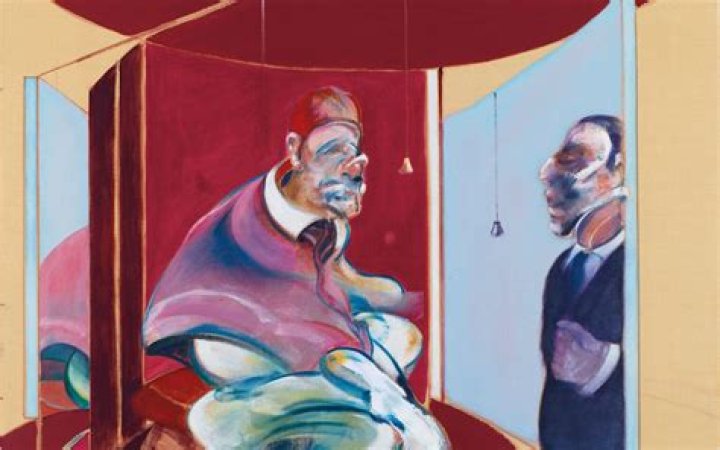
Beside above, was Francis Bacon a surrealist? Francis Bacon (1909-1992) was an Irish figurative painter, influenced in his earlier years by Picasso and surrealism, whose unique expressionist style of painting, which emerged during the 1950s, featured pictures of people screaming or in pain, often portrayed inside bathrooms or cages.
Similarly, what kind of artist is Francis Bacon?
Painting
What are the salient features of Bacon's prose style?
Bacon's style was suited for all occasions. His prose style was eminently fitted for such dignified subjects as Truth, Atheism and Love and also such ordinary subjects as 'Marriage and single life' and gardening. 'The adaptability to the subject matter was a characteristic quality of his writings.
Related Question Answers
What is the central theme of Bacon's essay?
Bacon's essays encompass topics like religion, personal wisdom, connections to other people, work, and moral quandaries. It seems as if Bacon has created a guidebook to explain to his readers how to examine different parts of their lives and find better ways to understand them.Who is known for aphoristic prose style?
Aphoristic style of Bacon. Introduction: Bacon's fame as a writer depends most of all on the fact that he is the father of modern English prose. He evolved a prose style that proved for the first time that English could also be used to express the subtleties of thought, in clear and uninvolved sentences.What does of studies by Francis Bacon mean?
In "Of Studies," Francis Bacon argues that studies are useful for "delight," "ornament," and "ability." In Bacon's view, studies help enrich life for both enjoyment and practical purposes. However, Bacon also believes that moderation is necessary for studies to be most useful.What were the most important elements of Bacon's prose style?
Bacon's style was suited for all occasions. His prose style was eminently fitted for such dignified subjects as Truth, Atheism and Love and also such ordinary subjects as 'Marriage and single life' and gardening. 'The adaptability to the subject matter was a characteristic quality of his writings.Was Francis Bacon a Catholic?
Religious beliefsBacon was a devout Anglican. He believed that philosophy and the natural world must be studied inductively, but argued that we can only study arguments for the existence of God.How are Bacon's essay an expression of brevity?
Bacon's style is aphoristic because there is a terseness of expression and an epigrammatic brevity in his style. His sentences are brief, rapid and forceful. Indeed, his essays are replete the aphorism. For example, "A lie faces God and shrinks from man."/"Suspicions among thoughts are like bats among birds."What nationality was Francis Bacon?
English
What inspired Francis Bacon?
The painter Francis Bacon was largely self-taught as an artist. As well as other visual artists, Bacon drew inspiration from the poems of T. S. Eliot, Ezra Pound and Yeats, the plays of Aeschylus, Sophocles and Shakespeare; Proust and Joyce's Ulysses.Why did Francis Bacon die?
Pneumonia
What is Francis Bacon most famous for?
Francis Bacon was an English Renaissance statesman and philosopher, best known for his promotion of the scientific method.What materials did Francis Bacon use?
Oil paints were used consistently for the painting of figures, but household paints were increasingly used in backgrounds from the 1960s onwards. A variety of different synthetic media are found in later works, including household acrylic paints and spray paints.Did Francis Bacon invent bacon?
Francis Bacon discovered and popularized the scientific method, whereby the laws of science are discovered by gathering and analyzing data from experiments and observations, rather than by using logic-based arguments.Who helped Francis Bacon?
The "father of classic liberalism," John Locke, as well as 18th-century encyclopedists and inductive logicians David Hume and John Mill, also showed Bacon's influence in their work. Today, Bacon is still widely regarded as a major figure in scientific methodology and natural philosophy during the English Renaissance.Where can I see Francis Bacon in London?
Where are they on display? Tate holds an extensive collection of Bacon paintings, some of which are part of Tate Britain's permanent display. You can also visit the reconstruction of Bacon's Reece Mews studio at Dublin City Gallery The Hugh Lane in Ireland.How did Francis Bacon impact the world?
Today, Bacon is still widely regarded as a major figure in scientific methodology and natural philosophy during the English Renaissance. Having advocated an organized system of obtaining knowledge with a humanitarian goal in mind, he is largely credited with ushering in the new early modern era of human understanding.What did Francis Bacon paint with?
Bacon purchased his linen canvas pre-primed with a white oil-based ground layer. Though later in his career he would routinely paint on the unprimed side of the commercially prepared linen canvas—as in Study of a Baboon (1952)—Painting was made on the primed side.What artist often painted from inside their car?
Roy Lichtenstein
How much is a Francis Bacon painting?
A painting by Francis Bacon of his friend and fellow artist Lucian Freud has become the most expensive artwork ever sold at auction after it fetched $142m (£89m, 106m euros) in New York. The triptych, Three Studies of Lucian Freud (1969), is considered one of Bacon's greatest masterpieces.Was Francis Bacon an alcoholic?
The same thing was happening in London: Francis Bacon (1909–92), who late in life claimed to have been 'drunk since the age of 15', could be found every afternoon in Soho's pubs and drinking clubs, and was a founder member of the famous Colony Room Club in 1948 – a private members' club that got around the restrictiveIs Francis Bacon still alive?
Deceased (1561–1626)