Also to know is, is tardive dyskinesia the same as akathisia?
Tardive dyskinesia is another side effect of treatment with antipsychotic medicines. It causes random movements — often in the face, arms, and trunk. Akathisia mainly affects the legs. The main difference between the conditions is that people with tardive dyskinesia don't realize they're moving.
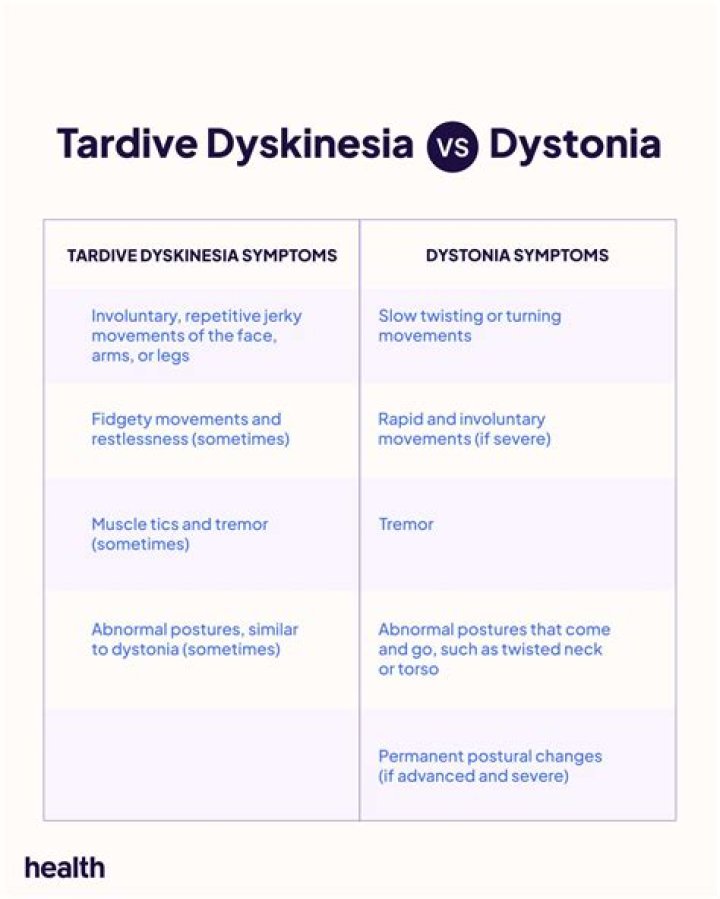
Similarly, what is the difference between TD and dystonia? Dystonia is defined as a syndrome of sustained muscle contractions, frequently causing twisting and repetitive movements, or abnormal postures. Tardive dyskinesia (TD), estimated to occur in 30% of patients treated with neuroleptics, encompasses a broad spectrum of hyperkinesias associated with exposure to these drugs.
In this way, what is the difference between TD and Parkinson's?
People with Parkinson's have difficulty moving whereas tardive dyskinesia patients have difficulty not moving. Additionally, the movements associated with tardive dyskinesia are more fluid and less jerky than spasms and stiffness experienced by those with Parkinson's.
What is the difference between tardive dyskinesia and tardive dystonia?
Tardive dyskinesia is characterized by truncal, appendicular, or orobuccolingual choreiform movements; whereas tardive dystonia manifests as stereotyped twisting and turning muscle spasms. Tardive dyskinesia also tends to have a later age of onset than tardive dystonia.
Related Question Answers
What are signs of akathisia?
The main sign of akathisia is a sense of restlessness and intense need to move. To relieve this feeling, you need to stay in motion.
People with akathisia are likely to:
- Rock back and forth.
- Pace or march in place.
- Shift their weight from foot to foot.
- Cross and uncross their legs.
- Squirm or fidget.
- Grunt or moan.
What does tardive dyskinesia look like?
Tardive dyskinesia is characterized by involuntary and abnormal movements of the jaw, lips and tongue. Typical symptoms include facial grimacing, sticking out the tongue, sucking or fish-like movements of the mouth.How do you calm akathisia?
Options include stopping the medication, lowering the dose of the current medication, switching to another medication or adding another medication that treats akathisia. Akathisia symptoms can be treated with a beta-blocker (such as propranolol (Inderal®)) or a benzodiazepine (like lorazepam (Ativan®)).What is similar to tardive dyskinesia?
“Tardive dyskinesia” is a term used for abnormal involuntary movements that begin after taking certain medications used to treat nausea or emotional problems. Tardive dyskinesia sometimes resembles chorea, dystonia, myoclonus, tics or tremor.How do they diagnose tardive dyskinesia?
Your doctor may do blood tests and brain imaging, like a CT or MRI scan, to find out whether you have another disorder that causes abnormal movements, such as: Cerebral palsy. Huntington's disease.Is Dystonia a form of dyskinesia?
Dystonia may sometimes be confused with dyskinesia. However, instead of involuntary movements of dyskinesia, dystonia causes the muscles to suddenly tighten involuntarily. It's caused by Parkinson's disease itself and not a side effect of the medication.Does Michael J Fox have tardive dyskinesia?
His character has dyskinesia, a condition which causes sudden movements. Dyskinesia can occur as a side effect of medication to treat Parkinson's.How do you reverse tardive dyskinesia?
In some cases, tardive dyskinesia can be reversed, especially if it's caught early.
There are a few options to try.
- Stop the medication causing tardive dyskinesia symptoms.
- Switch to a newer antipsychotic.
- Add medications that specifically treat tardive dyskinesia.
- Remember prevention and early detection are best.
What does dyskinesia feel like?
Dyskinesias are involuntary, erratic, writhing movements of the face, arms, legs or trunk. They are often fluid and dance-like, but they may also cause rapid jerking or slow and extended muscle spasms. They are not a symptom of Parkinson's itself. Rather, they are a complication from some Parkinson's medications.Is tardive dyskinesia from too much dopamine?
Too much damage to the cell causes the death of dopaminergic neurons. The accumulation of this damage and cell death can lead to tardive dyskinesia. Even short-term use of D2 blockers causes damage to dopaminergic neurons.Which drugs can cause tardive dyskinesia?
Tardive dyskinesia (TD) is a disorder that involves involuntary movements.
Medicines that most commonly cause this disorder are older antipsychotics, including:
- Chlorpromazine.
- Fluphenazine.
- Haloperidol.
- Perphenazine.
- Prochlorperazine.
- Thioridazine.
- Trifluoperazine.
Is tardive dyskinesia serious?
Tardive dyskinesia (TD) is a serious side effect that may occur with certain medications used to treat mental illness. TD may appear as repetitive, jerking movements that occur in the face, neck, and tongue. The symptoms of TD can be very troubling for patients and family members.Do antipsychotics cause Parkinson's disease?
Dopamine receptors are widely distributed in the brain, and typical antipsychotics may act on dopamine receptors in the striatum. Therefore, all patients taking antipsychotics have some risk of developing parkinsonism and other EPS.What causes a person to shake?
Causes of tremor include neurological disorders, neurodegenerative diseases, drugs, mercury poisoning, overactive thyroid and liver failure. There are several types of tremor. Treatment depends upon the type of tremor and availability of medications for the condition.Does tardive dyskinesia lead to Parkinson's disease?
Is tardive dyskinesia a symptom of Parkinson's disease? Tardive dyskinesia is not a symptom of Parkinson's disease. It's a separate movement disorder caused by long-term use of anti-psychotic medications. In addition to being a side effect of different medications, tardive dyskinesia also has its own set of symptoms.Which medication is associated with the highest risk of tardive dyskinesia?
Risk factorsTaking neuroleptics, especially over an extended period, is the biggest risk factor for developing tardive dyskinesia.