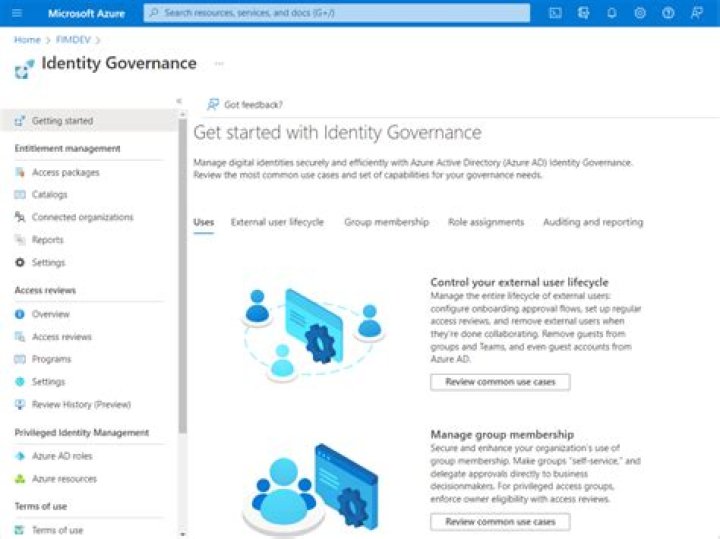
Just so, what is azure governance?
Azure governance features and services Apply policies with flexible hierarchies to multiple subscriptions. Easily create fully compliant environments and apply group policies to new Azure subscriptions. Do inventory management. Azure Resource Graph. Get visibility into all your resources—fast.
Additionally, what is Azure Active Directory? Azure Active Directory (Azure AD) is Microsoft's cloud-based identity and access management service, which helps your employees sign in and access resources in: Internal resources, such as apps on your corporate network and intranet, along with any cloud apps developed by your own organization.
Similarly one may ask, what is azure identity management?
Azure AD is a multitenant, cloud-based directory and identity management service from Microsoft. It combines core directory services, application access management, and identity protection into a single solution.
What is identity life cycle?
An identity life cycle is a term for the full life cycle of identity and access for a user on a given system. This is often used in a business context, when someone is talking about identity life cycle management, systems that handle the entire context of someone accessing data on a company's network.
Related Question Answers
How do I monitor Azure?
Create a queryStart by opening the Log Search portal. In the Azure portal, click All services. In the list of resources, type Monitor.What is a cloud governance model?
Cloud Governance is the people, process, and technology associated with your cloud infrastructure, security, and operations. Governance involves a framework with a set of policies and standard practices. This could include policies for cost optimization, resiliency, security, or compliance.What is azure scaffold?
Azure Scaffold and Cloud First Development. The Azure Scaffold is an abstract way of thinking of how the pieces of Azure on build each other as your environment takes shape. Similar to a structure in the real world, the foundation is the most important thing and it is what allows for building bigger and better things.What is azure landing zone?
More specifically, a landing zone is the basic building block of any cloud adoption environment. Principle purpose: The principle purpose of the landing zone is to ensure that when an application lands on Azure, the required "plumbing" is already in place.What is cloud governance?
Cloud Governance is the people, process, and technology associated with your cloud infrastructure, security, and operations. This should not be confused with cloud management, Forrester cautions. Governance involves a framework with a set of policies and standard practices.What is azure cloudyn?
Azure Cost Management by Cloudyn is a software as a service (SaaS) cost management and monitoring tool for multi-cloud environments. Microsoft has said, however, that the tool will continue to work with both the Amazon Web Services (AWS) and Google Cloud Platform (GCP) public clouds, as well as Azure.What is azure arc?
Azure Arc is a much broader hybrid cloud platform with support for a variety of compute environments running in the enterprise data center. If the environment is capable of running a managed Kubernetes cluster, Azure Arc can deploy data services.What is azure advisor?
Azure Advisor is a new Microsoft Azure service which provides personalized recommendations based on individual user needs. “Advisor is a personalized cloud consultant that helps you follow best practices to optimize your Azure deployments.What is the difference between ad and Azure AD?
First, you should know that Windows Server Active Directory wasn't designed to manage web-based services. Azure Active Directory, on the other hand, was designed to support web-based services that use REST (REpresentational State Transfer) API interfaces for Office 365, Salesforce.com etc.Is Azure AD SaaS or PaaS?
Office 365 is SaaS, which provides an online version of MS Office Suite (Office Web Apps) along with SharePoint Server, Exchange Server and Lync Server. Windows Azure is both IaaS and PaaS, which makes the Windows Server operating system and other features available as services.How does Azure authentication work?
Azure AD, on receiving the request to sign in, places the username and password (encrypted by using the public key of the Authentication Agents) in a queue. An on-premises Authentication Agent retrieves the username and encrypted password from the queue.Can Azure replace Active Directory?
Unfortunately, the short answer to this question is no. Azure AD is not a replacement for Active Directory. Azure Active Directory is not designed to be the cloud version of Active Directory. It is not a domain controller or a directory in the cloud that will provide the exact same capabilities with AD.What is azure b2b?
Azure Active Directory (Azure AD) business-to-business (B2B) collaboration lets you securely share your company's applications and services with guest users from any other organization, while maintaining control over your own corporate data.Is Active Directory an identity management system?
Active Directory and Microsoft's Identity ManagementMicrosoft Active Directory, on the other hand, is a Microsoft Windows-centric identity provider for on-prem systems and applications. IT admins have leveraged Active Directory as their central point of control for Windows users and systems.What is identity governance & administration?
Identity Governance & Administration (IGA) is commonly defined as “the policy-based centralized orchestration of user identity management and access control. An IGA solution works with your Identity and Access Management (IAM) process to: Automate workflows.How do I secure my Azure AD?
General preparation- Turn on Azure AD Privileged Identity Management.
- Identify and categorize accounts that are in highly privileged roles.
- Define at least two emergency access accounts.
- Turn on multi-factor authentication and register all other highly privileged single-user non-federated admin accounts.
Is Azure AD an identity provider?
Azure Active Directory (Azure AD) is a third-party identity provider that can act as the IdP when your users log on to the Web Console or the Command Center. To integrate with Azure AD, add a SAML application in the Command Center and in your Azure AD account.How does Azure Connect to Active Directory?
Select Azure Active Directory, and then select Connect directory. Select a directory from the dropdown menu, and then select Connect.Why do I need Azure AD?
Cost-effective and easy to use, Azure AD helps businesses streamline processing, and improve productivity and security, while single sign-on (SSO) gives employees and business partners access to thousands of cloud applications – such as Office 365, Salesforce, and DropBox.How much is Azure Active Directory?
The Basic version of Azure Active Directory costs $1 per user per month (with standard volume licensing discounts available) with access to up to 10 apps per user. The Premium version, in standalone form, costs $4 per user per month.Do you need Active Directory?
No! You don't need to continue to leverage Active Directory as you make the move to the cloud. In fact, you don't need to do a lot of the things the same way you've been doing them in the past.What is Azure AD and how it works?
Azure Active Directory (Azure AD) is Microsoft's cloud-based identity and access management service, which helps your employees sign in and access resources in: Internal resources, such as apps on your corporate network and intranet, along with any cloud apps developed by your own organization.Does Azure AD use LDAP?
To communicate with your Azure Active Directory Domain Services (Azure AD DS) managed domain, the Lightweight Directory Access Protocol (LDAP) is used. With Azure AD DS, you can configure the managed domain to use secure Lightweight Directory Access Protocol (LDAPS).Why do we need Active Directory?
Why is Active Directory so important? Active Directory helps you organize your company's users, computer and more. Your IT admin uses AD to organize your company's complete hierarchy from which computers belong on which network, to what your profile picture looks like or which users have access to the storage room.What is tenant in Azure AD?
A tenant represents an organization in Azure Active Directory. It's a dedicated Azure AD service instance that an organization receives and owns when it signs up for a Microsoft cloud service such as Azure, Microsoft Intune, or Office 365.What does IAM mean?
Identity and Access Management