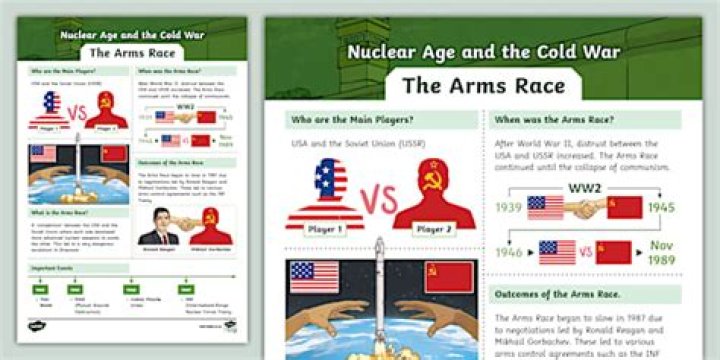
For the most part, the Arms Race came to an end with the collapse of the Soviet Union at the end of the Cold War in 1991.
In respect to this, what treaty ended the arms race?
Détente and Disarmament
The SALT I Treaty also put limits on numbers of Intercontinental Ballistic Missiles and submarine launched ballistic missiles.
Likewise, did the various weapons treaties end the arms race? Arms Races Continue
The Cold War ended in 1991; however, in 1987, the United States and the Soviet Union had signed the Intermediate-Range Nuclear Forces Treaty (INF) to limit the scope and reach of all types of missiles.
Also to know, when did the arms race begin and end?
Nuclear weapon test, 1956The destruction of the Japanese cities of Hiroshima and Nagasaki by American atomic weapons in August 1945 began an arms race between the United States and the Soviet Union. This lasted until the signing of the Conventional Forces in Europe treaty of November 1990.
What happened in the arms race?
Not long after World War II ended in 1945, new hostilities emerged between the United States and the Soviet Union. Initially, only the United States possessed atomic weapons, but in 1949 the Soviet Union exploded an atomic bomb and the arms race began. Both countries continued building more and bigger bombs.
Related Question Answers
How do you end the arms race?
In order to try and slow down the Arms Race, the countries agreed to reduce arms through the SALT I and SALT II agreements. SALT stood for Strategic Arms Limitation Talks. For the most part, the Arms Race came to an end with the collapse of the Soviet Union at the end of the Cold War in 1991.What is the arms race cold war?
The nuclear arms race was an arms race competition for supremacy in nuclear warfare between the United States, the Soviet Union, and their respective allies during the Cold War.Why is an arms race dangerous?
They are widely believed to have significant consequences for states' security, but agreement stops there. In the debate over their consequences, one side holds that arms races increase the probability of war by undermining military stability and straining political relations.Does arms race lead to war?
It is shown that, depending on the initial and final configuration of weapons on both sides, an arms race could lead not only to war but to peace. Conversely, a disarming race could lead not only to peace but to war.Why is ARM control important?
By prohibiting or limiting the deployment of offensive weapons while allowing the deployment of defensive ones, arms control can shape the offense-defense balance, strengthen crisis stability, ameliorate security dilemmas, strengthen deterrence, and ultimately prevent war.What is the arms race and mutually assured destruction?
As such, historians refer to the nuclear arms race of the Cold War as an example of Mutual Assured Destruction since it was clear to both the United States and the Soviet Union that if either attacked the other, then it would ultimately lead to total destruction for both.Why did the arms race cause tension?
Development of the arms raceBoth sides feared falling behind in research and production. Eventually, nuclear weapons became a deterrent rather than a weapon for use in warfare. Tension was greatly increased as a result of the developing arms race which served to militarise both sides and bring war closer.
What was the arms race in World War 1?
From 1897 to 1914, a naval arms race between the United Kingdom and Germany took place. British concern about rapid increase in German naval power resulted in a costly building competition of Dreadnought-class ships. This tense arms race lasted until 1914, when the war broke out.What was a major outcome of the arms race?
Answer: The Soviet Union and the United States built tens of thousands of nuclear weapons.Did Hiroshima start the Cold War?
The Hiroshima Bombing Didn't Just End WWII—It Kick-Started the Cold War. The colossal power of the atomic bomb drove the world's two leading superpowers into a new confrontation.What year did the arms race peak?
1967
Are hydrogen bombs real?
For this reason, thermonuclear weapons are often colloquially called hydrogen bombs or H-bombs. In modern weapons fueled by lithium deuteride, the fissioning plutonium spark plug also emits free neutrons which collide with lithium nuclei and supply the tritium component of the thermonuclear fuel.How did hostilities increase between the US?
How did hostilities increase between the United States and the Soviet Union during the 1950s? The CIA intervened with the communist situations. Then the Soviets' alliance with its satellite nations (Warsaw Pact). The U.S. wanted to build a more powerful weapon to maintain control and power.What started cold war?
The Cold War began after the surrender of Nazi Germany in 1945, when the uneasy alliance between the United States and Great Britain on the one hand and the Soviet Union on the other started to fall apart.How did the US develop nuclear weapons?
The United States first began developing nuclear weapons during World War II under the order of President Franklin Roosevelt in 1939, motivated by the fear that they were engaged in a race with Nazi Germany to develop such a weapon.How did ww2 lead to the Cold War?
As World War II transformed both the United States and the USSR, turning the nations into formidable world powers, competition between the two increased. Following the defeat of the Axis powers, an ideological and political rivalry between the United States and the USSR gave way to the start of the Cold War.What does détente mean?
release from tension
How did the arms race affect the United States?
The nuclear arms race resulted in widespread anxiety for both the American and Soviet peoples. In the United States, some families built homemade underground bomb shelters.How did the arms race impact American citizens and culture?
The US government's decision to develop a hydrogen bomb, first tested in 1952, committed the United States to an ever-escalating arms race with the Soviet Union. The arms race led many Americans to fear that nuclear war could happen at any time, and the US government urged citizens to prepare to survive an atomic bomb.What was agreed in salt 1?
SALT I Treaty. SALT I is the common name for the Strategic Arms Limitation Talks Agreement signed on May 26, 1972. One of the terms of the treaty required both countries to limit the number of deployment sites protected by an anti-ballistic missile (ABM) system to one each.How do you get to the arms race?
Borderlands 3: How to Start Arms Race- Fast Travel to Sanctuary 3.
- Pick up the quest from the Arms Race poster. You can find the Arms Race poster across the hallway from the Lost Loot Machine.
- Fast Travel to Stormblind Complex on Pandora.
- Activate the Portal.
- Jump in the portal.