Subsequently, one may also ask, is salary sacrifice a good idea?
In short, salary sacrifice pension schemes are can be a good, tax-efficient use of your earnings to fund a more comfortable retirement. That's because aside from any profit from investment decisions, your pension will grow by more than the additional contribution you put in from your salary sacrifice.
Also, can I opt out of salary sacrifice? You'll sign a salary sacrifice contract with your employer, where you agree to forgo a certain amount of pay in return for certain benefit. You can usually change the amount of money you sacrifice, but this has to be agreed with your employer. You can opt out of salary sacrifice at any time.
Beside this, can I salary sacrifice my entire wage?
According to the ATO, you can agree with your employer to 'sacrifice' some of your salary or wages by having them paid straight into your super fund instead of direct to you. This will be treated as an employer super contribution and will be taxed at a maximum rate of 15%, the ATO says.
What are the cons of salary sacrifice?
The risks and disadvantages associated with a salary sacrifice arrangement include lack of accessibility, fluctuations in savings and possible reduction in employer contributions. While these are the main disadvantages of salary sacrifice arrangements, other risks also exist.
Related Question Answers
How does salary sacrifice affect tax?
The employee pays income tax on the reduced salary or wage. Salary sacrificed (pre-tax) superannuation contributions are classified as employer contributions (not employee contributions). The employer may be liable to pay fringe benefits tax (FBT) on the fringe benefits provided.What is the difference between salary sacrifice and salary deduction?
Many companies offer both options within their employee benefits package, but it's sometimes not clear what the difference is. Make sure you're in the know before you commit to anything.
Salary deduction vs salary sacrifice - What's the difference?
| Salary Sacrifice | Salary Deduction |
|---|---|
| Makes a difference to your total salary | Doesn't make a difference to your total salary |
What does salary sacrifice mean on payslip?
'Salary sacrifice' (also called 'salary exchange') is an arrangement employers may make available to employees – the employee agrees to reduce their earnings by an amount equal to the employee's pension contributions. Using salary sacrifice means that the employee and employer pay less National Insurance contributions.Is it better to salary sacrifice super before or after tax?
Salary sacrifice is a contribution you make to your super from your before-tax pay. Salary sacrifice reduces your taxable income, so you pay less income tax. Only 15% tax is deducted from your salary sacrifice amount compared to the rate you pay on your income, which can be up to 47% (including the Medicare Levy).Should I salary sacrifice a car?
Here's one of the most cost-effective and tax-effective ways for an ordinary mortal on a salary to own a new car. Novated leasing - also called 'salary sacrifice' - makes real sense for a lot of employees. It's often the best way to own a new car. You can even do it on late-model used cars.Does salary packaging affect your tax return?
Put simply, it's a 'yes'. Salary packaging / salary sacrifice is an arrangement whereby you only pay income tax on your reduced salary – that is, the amount left over in your pay packet after your agreed benefit(s) have been deducted.How much can I salary sacrifice super 2020?
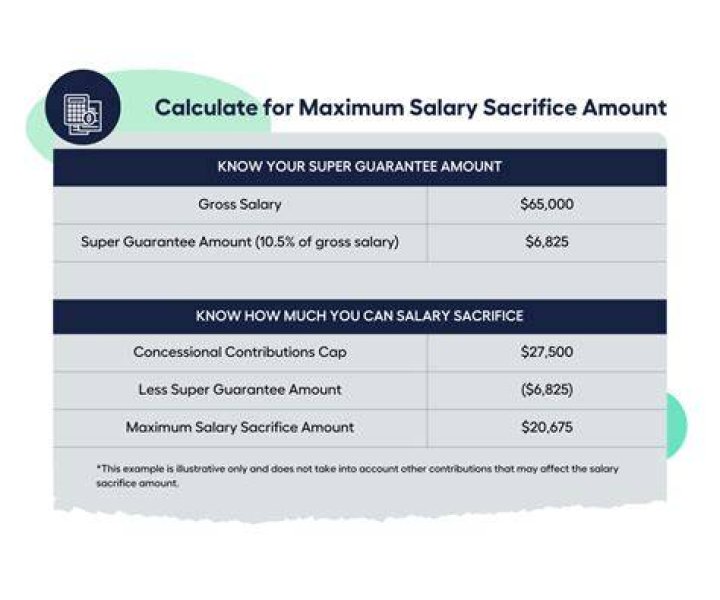
Are there limits to how much I can contribute? Yes. If you want to claim a tax deduction, the maximum that can be paid into your super account each year (including any salary sacrifice and the super your employer pays you) is $25,000.What happens if you pay more than $25000 into super?
The short answer is, if you go over your concessional contributions cap, the excess amount is included in the amount of assessable income in your tax return and you pay tax on it at your marginal tax rate.Should I pay off mortgage or add to super?
Once you contribute money to your super you generally can't access it again until you retire. If you'll need the money before you retire, paying off your mortgage is a better option because you may be able to redraw the money or access the equity in your home.What is the lowest tax threshold?
Income Tax rates and bands
| Band | Taxable income | Tax rate |
|---|---|---|
| Personal Allowance | Up to £12,500 | 0% |
| Basic rate | £12,501 to £50,000 | 20% |
| Higher rate | £50,001 to £150,000 | 40% |
| Additional rate | over £150,000 | 45% |
How does salary sacrifice super work?
Salary sacrifice is an arrangement with your employer to forego part of your salary or wages in return for your employer providing benefits of a similar value. One example of a salary sacrifice arrangement is to have some of your salary or wages paid into your super fund instead of to you.Is salary sacrifice super tax deductible?
An employee can 'sacrifice' part of their salary or wages into super contributions under an agreement with you. You then pay the sacrificed amount to your employee's super fund on their behalf. the contributions are tax deductible.How can I reduce my taxable income?
15 Legal Secrets to Reducing Your Taxes- Contribute to a Retirement Account.
- Open a Health Savings Account.
- Use Your Side Hustle to Claim Business Deductions.
- Claim a Home Office Deduction.
- Write Off Business Travel Expenses, Even While on Vacation.
- Deduct Half Your Self-Employment Taxes.
- Get a Credit for Higher Education.