- Book.
- Newspapers and magazines.
- Peer reviewed journals.
- Peer reviewed articles.
- PhD or MBA dissertations and research.
- Public library.
- Scholarly articles.
Similarly one may ask, how do you know if a source is unreliable?
There are several main criteria for determining whether a source is reliable or not.
- 1) Accuracy. Verify the information you already know against the information found in the source.
- 2) Authority. Make sure the source is written by a trustworthy author and/or institution.
- 3) Currency.
- 4) Coverage.
Likewise, what is an example of a credible online source? Credible websites
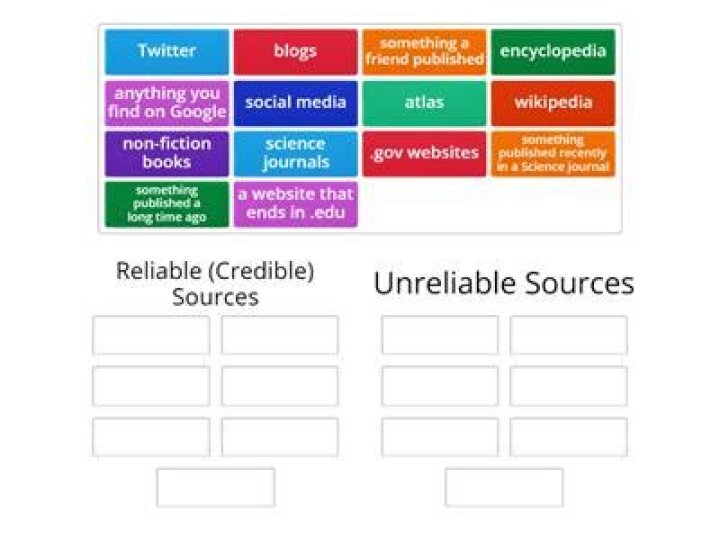
Government and educational websites (. gov or . edu), such as those of universities, are your safest bet for finding accurate information with no hidden agenda. You might be tempted to use and cite Wikipedia, but you need to be very careful with this as it is not considered a proper academic source.
Also Know, why are Internet sources unreliable?
Top Ten Reasons for Evaluating Internet Sources
#1 There is no quality assurance when it comes to information found on the Internet: Anyone can post anything. #2 In most cases, information found on the web has not been checked for accuracy. #3 Not all web sites are created equal.
What is an example of an unreliable source?
The following are unreliable sources because they require confirmation with a reliable source: Wikipedia: although this is a good starting point for finding initial ideas about a topic, some of their information and attached resources may not be reliable. Blogs, tweets. Personal websites.
Related Question Answers
What makes a bad source?
Bad Online SourceArticle has been peer reviewed (often called scholarly or academic articles) Article has not been peer reviewed.
Which sources are reliable?
Types of Reliable SourcesScholarly, peer-reviewed articles or books -written by researchers for students and researchers. Original research, extensive bibliography. Found in GALILEO's academic databases and Google Scholar. Anatomy of a Scholarly Article.
What is the danger of using unreliable websites?
Unreliable websites will give you bad informationYou can be reading outdated information. It can be written by someone who doesn't know about the topic.
How can you tell if a website is trustworthy?
With that in mind, here are eight ways to tell if a website is reliable.- Look for Established Institutions.
- Look for Sites with Expertise.
- Steer Clear of Commercial Sites.
- Beware of Bias.
- Check the Date.
- Consider the Site's Look.
- Avoid Anonymous Authors.
- Check the Links.
How do you know information is credible?
How to determine if a source is credible?- Examine the source's and author's credentials and affiliations.
- Evaluate what sources are cited by the author.
- Make sure the source is up-to-date.
- Check the endorsements and reviews that the source received.
- Check if the publisher of the source is reputable.
Is .org a credible source?
Check the domain nameLook at the three letters at the end of the site's domain name, such as “edu” (educational), “gov” (government), “org” (nonprofit), and “com” (commercial). Generally, . edu and . gov websites are credible, but beware of sites that use these suffixes in an attempt to mislead.
What are some examples of reliable sites?
Just type in the information you need to find, and get a list of credible websites.- Google Scholar.
- iSeek.
- Microsoft Academic.
- Refseek.
- OCLC.org.
- Dogpile.
- Core.