Just so, how do I stop a garnishee order?
Apply to Pay the Debt in Instalments If the court accepts your application, the Garnishee Order will be stopped. If this option works best for you, you must keep up with the payment plan you've agreed on with the court.
Likewise, how long does it take to get a garnishee order? The court will send notices to you and your bank or employer, and the garnishment will begin in five to 30 business days, depending on your creditor and state.
Beside this, how do you serve a garnishee order from a bank?
You need a judgment from the court before you can apply for a garnishee order for debts.
?You can file the notice of motion garnishee order online using the NSW Online Registry?.
- Step 2: Fill out the forms.
- Step 3: File the forms.
- Step 4: Serve the garnishee order.
- Step 5: Debts garnished.
Can you stop a garnishment once it has been started?
You must take action to prevent the initial garnishment or address it if it has already started by claiming an exemption with the court. The creditor will continue to garnish your wages until you pay the debt in full or take some measure to stop the garnishment, such as by filing for bankruptcy (see below).
Related Question Answers
What are the main effects of garnishee order?
There are three main ways that garnishee orders work.- Recovering debt from wages and salary. A garnishee order can allow the judgement creditor to recover debt from the debtor's wages and salary.
- Recovering debt from bank accounts.
- Recovering debt from people who owe money to the debtor.
How can I protect my bank account from garnishment?
Avoiding Frozen Bank Accounts- Don't Ignore Debt Collectors.
- Have Government Assistance Funds Direct Deposited.
- Don't Transfer Your Social Security Funds to Different Accounts.
- Know Your State's Exemptions and Use Non-Exempt Funds First.
- Keep Separate Accounts for Exempt Funds, Don't Commingle Them with Non-Exempt Funds.
Can you set up a payment plan after garnishment?
Removing a Levy or Wage Garnishment. When the IRS takes money out of your bank account (levy) or your paycheck (wage garnishment), you have options. You can get the IRS to remove the levy, but only after you pay off all the back taxes you owe, or set up a payment agreement with the IRS.How much money can be garnished from my bank account?
A wage garnishment means the creditor takes funds directly from your paycheck. And yes, the creditor can levy your bank account down to the last penny. The creditor can only take up to the amount you owe, of course. If you owed $10,000 and have $5,000 in the bank, then the levy can take everything.Can you reverse a garnishment?
One way to end your wage garnishment is to call your creditor and get them to agree to a repayment plan. Look at your budget and see what you can pay. Then can call your creditor and see if they will agree to a repayment plan for you to pay a lower monthly amount than the garnishment.Does your employer have to notify you of garnishment?
The employer usually has to notify the debtor in writing that wage garnishment is about to start before sending payments directly to the creditor in question. The wage garnishment then typically continues until the debts are paid off. There are a number of protections in place for employees whose wages are garnished.How much does a garnishee order cost?
This can be done at the Office of the Clerk of the Court at the time you file your Garnishee Summons. A $25.00 administration fee must be paid to the garnishee with the Garnishee Summons. In most cases, the Garnishee Summons is effective for two years.What is garnishee order in simple words?
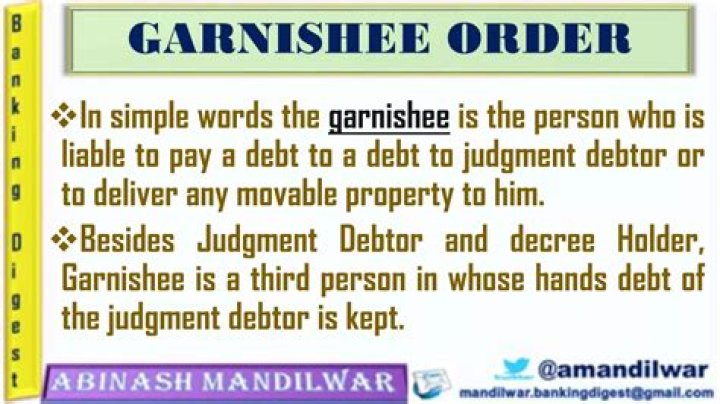
A garnishee order is a common form of enforcing a judgment debt against a creditor to recover money. Put simply, the court directs a third party that owes money to the judgement debtor to instead pay the judgment creditor. The third party is called a 'garnishee'. the debtor's bank account, or.What do you know about garnishee order?
A garnishee order is a legal notice the court issues that allows the creditor to collect the amount from either: the debtor's wages, the debtor's bank account, or. other people who owe the debtor money (e.g. a real estate agent who is collecting rent).How long does it take a creditor to garnish your wages?
The court will send notices to you and your bank or employer, and the garnishment will begin in five to 30 business days, depending on your creditor and state. The garnishment continues until the debt, potentially including court fees and interest, is paid.Can you garnish a company?
Garnishment is a course of last resort -- indeed, a business can only initiate the garnishment process after it establishes that the other company owes it a debt. To do so, the company must prevail against the debtor in court.What is garnishee order with example?
A garnishee order is a common form of enforcing a judgment debt against a creditor to recover money. Put simply, the court directs a third party that owes money to the judgement debtor to instead pay the judgment creditor. The third party is called a 'garnishee'. the debtor's bank account, or.What is attachment order?
Income Tax Department's Attachment OrderIncome Tax (IT) Attachment Order is an order issued under Sec. 226(3) of Income Tax Act, 1961, by an Income Tax Department for recovery of statutory dues from a person under respective law. The order is issued in case of income tax default.What is the difference between a debtor and a creditor?
The difference between a debtor and a creditor. A creditor is an entity or person that lends money or extends credit to another party. A debtor is an entity or person that owes money to another party. Thus, there is a creditor and a debtor in every lending arrangement.How do I pay a garnishment?
You can pay the debt by giving the other party the amount of the writ in full including any court costs or levies. For more information, see Paying the judgment. If you cannot pay this amount in full, you could try to come to an arrangement with the other party as to how it will be paid.Can collections garnish wages?
Yes a debt collector can garnish your wages IF they have obtained a judgement in court to do so. If the debt is relatively small, however, it is unlikely that the collection agency will pursue a judgement for wage garnishment due to the legal fees involved.How do I find out about a garnishment?
Search the Court RecordsThe second is the order for garnishment or bank levy. Both of these judgments will appear in the court records. Generally, the clerk of the local county court where the debtor lives and/or works will be able to say if there are any "live" garnishment judgments on file.What is the maximum amount that can be garnished from a paycheck?
25%