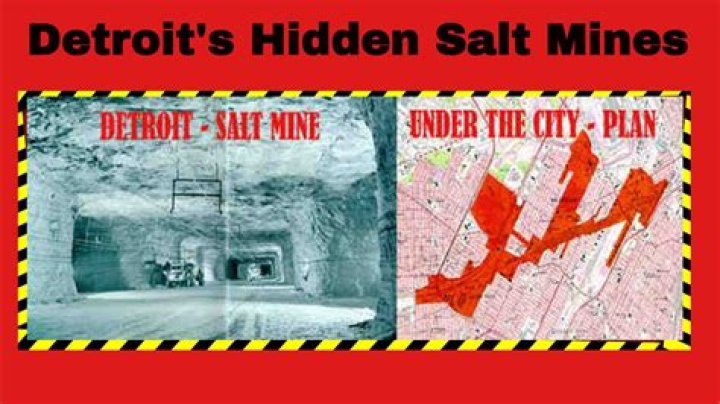
Keeping this in consideration, do they still mine salt in Detroit?
In 1997, the Detroit Salt Company, LLC, purchased the mine from Crystal Mines, Inc. and began salt production in the fall of 1998. Although the leather and food industries were once large customers to the Detroit mine, road deicing salt is the only product the mine currently provides.
Furthermore, is it hot or cold in the Detroit Salt Mine? The mine temperature stays around 60°Fahrenheit (16° Celsius) year round, so it's warmer than the surface in the winter and cooler than the surface in the summer.
Similarly one may ask, can you tour the Detroit salt mines?
Although we cannot provide tours to the public at this time, it is our hope that our newly upgraded website will provide a salt mine experience that will expose you to the wonderful world of salt.
Are there salt mines in Michigan?
The biggest salt dry-mining operation in Michigan today is in Wayne County. The Detroit Salt Company produced the first salt there in 1895. Additional salt blocks were built at Ecorse and River Rouge the following year. Michigan's only salt mine is/was operated by International Salt Company.
Related Question Answers
Where is the largest salt mine in the world?
Sifto Salt Mines in OntarioThis Canadian salt mine holds the distinction of being the largest salt mine in the world. It is located 1800 feet under Lake Huron.Where is the largest salt mine in the United States?
Western New York and Central New York, location of American Rock Salt, the largest operating salt mine in the United States with a capacity for producing up to 18,000 tons each day.Are diamonds found in Michigan?
That's what's been said since the late 1800's. Jack Van Alstine, geologist at the Michigan State Department of Natural Resources at Marquette, said diamonds have been found in northern Michigan and Wisconsin within the last 100+ years. Diamonds that floated down on glaciers have been found in the area.Can we run out of salt?
Can the planet ever run out of salt? Therefore, the sodium and chloride ions that compose salt don't really go anywhere. Theoretically, they can be combined into table salt at any time given enough energy. Energy, though, that's what the real crux of your question is.Where is the entrance to the Detroit salt mines?
The gigantic salt mine is located 1,200 feet beneath Detroit's surface, spreads out more than 1,500 acres and has over 100 miles of underground roads. The mineshaft opening is located at 12841 Sanders Street in Detroit, Michigan.Are there any salt mines in the United States?
Your salt might come from a mine in Ohio or Quebec, or a solar evaporation site—where it's crystalized by the sun in open pools—in Florida or New Jersey. Cargill maintains three mines in the US, including one 1,800 feet below Cleveland, as well as bedded deposits in New York.Is Salt a mineral?
Salt is a mineral composed primarily of sodium chloride (NaCl), a chemical compound belonging to the larger class of salts; salt in its natural form as a crystalline mineral is known as rock salt or halite. Salt is present in vast quantities in seawater, where it is the main mineral constituent.Why does Detroit have steam?
The majority of the steam for the network is generated at Detroit Renewable Energy's waste-to-energy plant, which safely generates renewable energy in the form of electricity and steam by safely processing municipal solid waste.Are salt mines dangerous?
In general, salt mining is less dangerous than underground coal mining, which can release potentially combustible methane that must be carefully monitored, said Jurgen F. But salt mines have had problems, including a massive collapse of a salt mine near Rochester in 1994.What county is salt mined in Michigan?
Wayne County
What is the room and pillar method of mining?
Room and pillar (variant of breast stoping), is a mining system in which the mined material is extracted across a horizontal plane, creating horizontal arrays of rooms and pillars. To do this, "rooms" of ore are dug out while "pillars" of untouched material are left to support the roof overburden.What role did Wood play in the salt industry?
An excess of wood products at the time (late 1800's) provided the raw materials required to "dewater" the brine. When the lumber industry fell off, so did the salt brine industry. Those old wells simply drew the brine up, and evaporated the water.How deep are the salt mines in Detroit?
1,100 ft